Introduction
Markets move on more than fundamentals. They move on emotion, and in crypto, emotion moves fast. The Crypto Fear and Greed Index is a tool that tries to measure that emotion on a scale from 0 to 100.
Created by the analytics site Alternative.me, the index tracks several data sources to answer a simple question: is the market feeling fearful or greedy? This guide explains how the index works, what each zone means and how to use it responsibly.
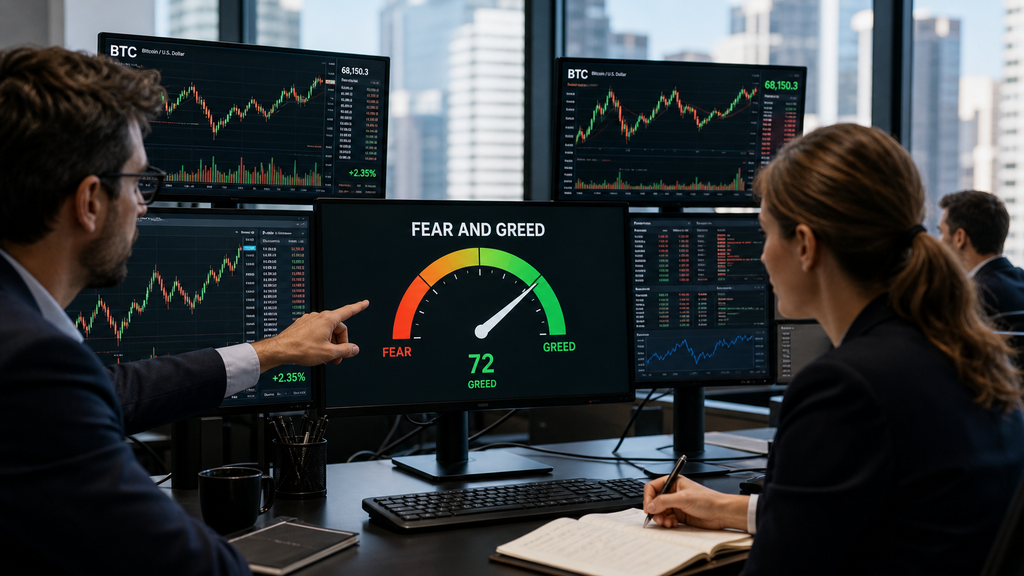
The index measures market sentiment on a scale of 0 to 100. AI-generated image.
What is the Fear and Greed Index?
The index compresses multiple market signals into a single number between 0 and 100. A reading near 0 means extreme fear. A reading near 100 means extreme greed.
The idea comes from a classic pattern: when markets are extremely fearful, prices tend to be low and opportunities larger. When markets are extremely greedy, prices tend to be stretched and risk higher. The index is a sentiment gauge, not a price prediction tool.
The five zones
| Zone | Range | What it suggests |
|---|---|---|
| Extreme Fear | 0–24 | Panic, heavy selling, possible opportunity |
| Fear | 25–44 | Cautious, defensive positioning |
| Neutral | 45–54 | Balanced, no strong signal |
| Greed | 55–74 | Optimistic, rising risk appetite |
| Extreme Greed | 75–100 | Euphoria, stretched prices, high risk |
How is the index calculated?
The index combines several components, each weighted differently:
- Volatility (25%): compares current volatility with historical averages. Higher volatility pushes the index toward fear.
- Market momentum and volume (25%): measures price movement and trading volume against recent averages. Strong momentum pushes the index toward greed.
- Social media (15%): tracks mentions and engagement on crypto social platforms. High engagement signals greed.
- Surveys (15%): direct polls of market participants, asking how they feel about the market.
- Bitcoin dominance (10%): measures Bitcoin’s share of total crypto market cap. Rising dominance can indicate fear toward altcoins.
- Google Trends (10%): search interest for Bitcoin-related terms. Very high or very low search volumes affect the score.
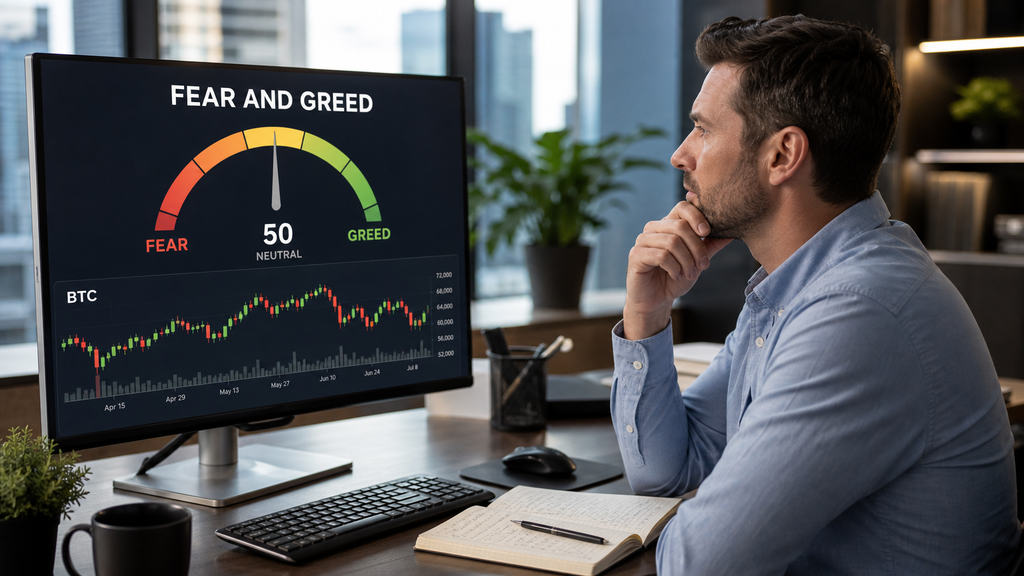
The index combines volatility, volume, social media, and Google searches. AI-generated image.
What do extreme readings mean?
- Extreme fear (0–24): historically associated with market bottoms. Investors panic and sell, and long-term buyers often find better entry prices. This is when the famous advice applies: “be fearful when others are greedy, and greedy when others are fearful”.
- Extreme greed (75–100): historically associated with market tops. Euphoria attracts late buyers, leverage rises and pullbacks become more likely. Caution matters more than excitement here.
The important nuance: extremes do not guarantee reversals. Markets can stay fearful or greedy for long periods, and the index is a context tool, not a timing tool.
How to use the index responsibly
- Use it as context, not as a signal to act blindly. Combine it with price analysis and fundamentals.
- Watch extreme zones for risk management. In extreme greed, reduce leverage and take profits gradually. In extreme fear, avoid panic selling.
- Do not overtrade. A daily number that moves a few points means little. Act only on sustained extremes.
- Pair it with other tools. Support and resistance levels, volume and on-chain data give you a more complete picture.

Use the index as context, not as a buy or sell order. AI-generated image.
Limitations you should know
- It is a lagging measure. The index reflects recent data, so it confirms sentiment that already formed.
- It measures emotion, not value. A high score does not mean an asset is overvalued, and a low score does not mean it is cheap.
- The components are snapshots. Social media and search data can be manipulated or skewed by hype campaigns.
- It is not financial advice. The index helps you think, it does not tell you what to do.
FAQ
Where can I check the Fear and Greed Index? The original version is published daily on Alternative.me. Many trading platforms and crypto data sites also display it.
Is extreme fear a good time to buy? Historically, extreme fear has often coincided with better long-term entry points, but there are no guarantees. Combine it with your own analysis and risk tolerance.
Does the index work for Bitcoin only? It was designed for the crypto market as a whole, but it is often used as a Bitcoin sentiment gauge. There are also versions for specific assets.
Can I use it alone to trade? No. The index is a sentiment context tool. Using it alone increases the risk of acting on incomplete information.
Disclaimer:
This article is for educational purposes only and does not constitute financial advice. Cryptocurrency markets are highly volatile. Always do your own research and never invest money you cannot afford to lose. This article may contain affiliate links: if you purchase through them, we may receive a commission at no additional cost to you.

