Bitcoin dominance is one of the most critical gauges for anyone looking to understand the rhythm of the crypto market. This indicator, which measures BTC’s share of the total crypto market cap relative to all other digital assets, acts as a behavioral roadmap for investors. When it rises or falls, we aren’t just seeing changing numbers—we are witnessing capital shifting between the safety of the world’s largest cryptocurrency and the exciting risk of altcoins.
Understanding the fluctuations of this metric is essential for identifying our current phase in the market cycle. Historically, a surge in Bitcoin dominance signals risk-averse periods, where investors seek shelter in the market’s pioneer asset. Conversely, a decline often paves the way for the highly anticipated “Altseason,” a phase where smaller tokens skyrocket and offer opportunities for exponential gains.
In this article, we will unpack the secrets behind Bitcoin dominance. You will learn how to read this indicator’s signals to anticipate major market moves and strategically structure your portfolio for every phase of the cycle.

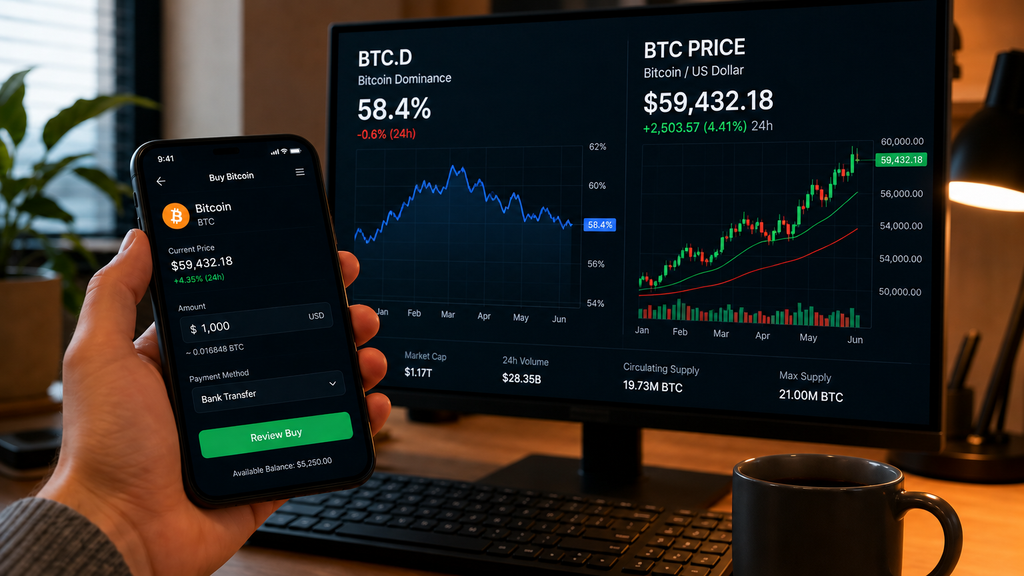
An investor analyzing Bitcoin dominance charts in a modern home office setup. AI-generated image.
Introduction
The crypto market is not a single asset. It is thousands of coins competing for attention and capital, and the relationship between them tells a story. Bitcoin dominance is the metric that captures that story in a single percentage.
When Bitcoin dominance rises, capital tends to flow into Bitcoin. When it falls, capital tends to spread into altcoins. Understanding this metric helps you read the mood of the market and position yourself with more context.

Bitcoin dominance measures BTC’s share of the total crypto market. AI-generated image.
What is Bitcoin dominance?
Bitcoin dominance is the percentage of the total cryptocurrency market capitalization that belongs to Bitcoin. It answers a simple question: how much of the value in crypto is held in Bitcoin versus everything else?
In the early days, Bitcoin dominance was close to 100%, because Bitcoin was the only cryptocurrency. As thousands of altcoins launched and grew, the percentage dropped. Today it fluctuates with market cycles, reflecting where investors are putting their money.
How is Bitcoin dominance calculated?
The formula is straightforward:
For example, if Bitcoin’s market cap is $1.2 trillion and the total crypto market cap is $2 trillion, Bitcoin dominance is 60%. The metric updates constantly as prices move, and it is published on major data sites like CoinMarketCap and TradingView.
Why does Bitcoin dominance matter?
- It reveals risk appetite. High dominance suggests investors prefer the relative safety of Bitcoin. Falling dominance suggests they are willing to take more risk with altcoins.
- It marks capital rotation. When dominance rises, money is leaving altcoins and moving into Bitcoin. When it falls, the opposite is happening.
- It helps identify altcoin seasons. Periods of rapidly falling dominance often coincide with strong altcoin rallies.
- It adds context to price analysis. A Bitcoin rally with rising dominance is different from a Bitcoin rally with falling dominance, where altcoins are leading.
Dominance reveals where capital is moving in the market. AI-generated image.
What do rising and falling dominance mean?
Rising dominance usually signals caution. Investors rotate into Bitcoin during uncertainty, bear markets or after altcoin bubbles burst. It can also happen during strong Bitcoin-specific rallies, like around a halving.
Falling dominance usually signals risk appetite. Capital spreads into altcoins, often during bull markets or when new narratives, like smart contract platforms or DeFi, capture attention. This is when “altcoin season” talk appears.
The key nuance: dominance is a relative measure. Bitcoin can fall in price while its dominance rises, if altcoins fall even harder. Always read it alongside the total market cap and Bitcoin’s own price action.
How to use Bitcoin dominance in your analysis
- Track the trend, not the daily wiggle. Dominance moves slowly. Focus on the medium-term direction, not day-to-day noise.
- Combine it with the total market cap. Rising dominance with a rising total cap is different from rising dominance with a falling total cap.
- Watch key levels. Like any chart, dominance has support and resistance. A breakout in dominance can signal a shift in market structure.
- Use it to filter altcoin ideas. When dominance is trending up, altcoins are generally under pressure. When it turns down, altcoin opportunities tend to improve.
- Never trade it alone. Dominance is context, not a signal. Combine it with price analysis, volume and fundamentals.

Use dominance as context, combined with other analyses. AI-generated image.
Limitations you should know
- It does not measure Bitcoin’s health. A high dominance can mean Bitcoin is strong, or simply that altcoins are crashing.
- Stablecoins distort the picture. USDT and USDC are counted in the total market cap, which can push Bitcoin dominance down even when Bitcoin is performing well.
- It is backward-looking. The metric reflects where money has been, not where it is going.
- It ignores on-chain activity. Dominance says nothing about network usage, fees or adoption.
FAQ
What is a good Bitcoin dominance level? There is no universal “good” level. Dominance has ranged from roughly 40% to over 70% across different cycles. What matters is the trend and how it interacts with the rest of the market.
Does high Bitcoin dominance mean a bear market? Not necessarily. High dominance can appear in bear markets, but also during strong Bitcoin rallies. Read it together with the total market cap and price trends.
What is an altcoin season? A period when altcoins outperform Bitcoin, usually marked by rapidly falling Bitcoin dominance and strong gains across smaller coins.
Where can I check Bitcoin dominance? Major crypto data sites like CoinMarketCap and TradingView publish it in real time, often under the ticker BTC.D.
Disclaimer:
This article is for educational purposes only and does not constitute financial advice. Cryptocurrency markets are highly volatile. Always do your own research and never invest money you cannot afford to lose. This article may contain affiliate links: if you purchase through them, we may receive a commission at no additional cost to you.

