Introduction
Bitcoin was the first cryptocurrency, but it is far from the only one. Thousands of other digital assets exist, and they are all called altcoins, short for “alternative coins”.
Altcoins are every cryptocurrency that is not Bitcoin. Some try to improve on Bitcoin’s limitations, others create entirely new use cases. Understanding what they are, how they differ and what risks they carry is essential before exploring this part of the market.
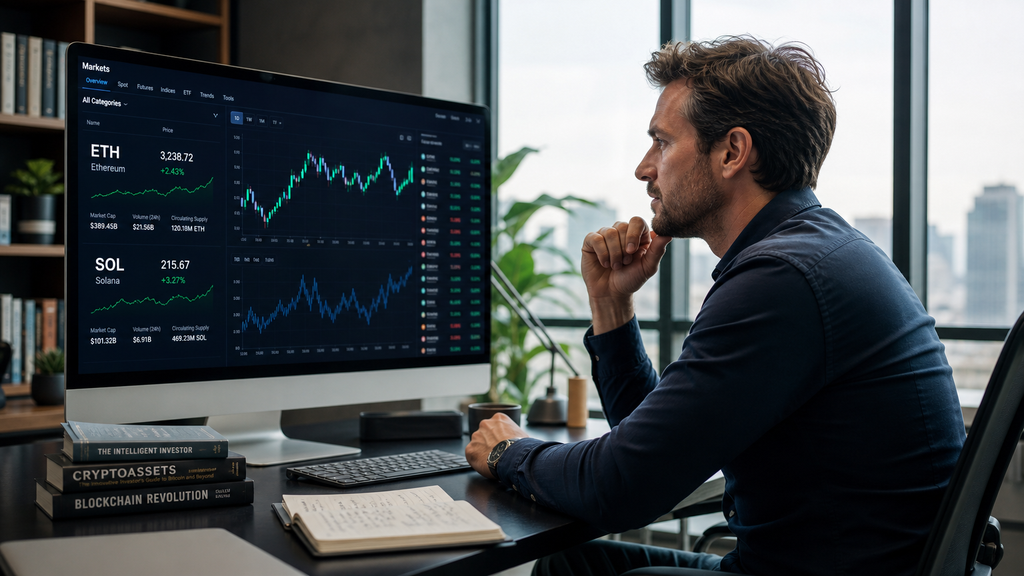
Altcoins are all cryptocurrencies other than Bitcoin. AI-generated images.
What exactly is an altcoin?
An altcoin is any cryptocurrency other than Bitcoin. The term covers an enormous variety of projects: from Ethereum and Solana to stablecoins like USDT and USDC, and even meme coins.
Altcoins appeared because Bitcoin was designed with a specific purpose in mind, digital money with a fixed supply. Other projects wanted to do different things, such as running smart contracts, powering decentralized applications or enabling faster payments. Each altcoin is a separate network, with its own code, its own rules and its own community.
Why do altcoins exist?
Bitcoin proved that decentralized digital money could work. Altcoins expand that idea in three main directions:
- Solving Bitcoin’s limitations: slower transaction speeds and limited programmability led to projects focused on speed, lower fees or more flexible blockchains.
- New use cases: smart contract platforms, decentralized finance (DeFi), gaming tokens and digital identity are examples of applications that go far beyond payments.
- Speculation and culture: meme coins exist mostly for community, hype and speculation. They have little practical use and very high risk.
The main types of altcoins
| Type | What it does | Examples |
|---|---|---|
| Smart contract platforms | Run programs and decentralized apps on blockchain | Ethereum, Solana, Cardano |
| Stablecoins | Keep a stable value, usually pegged to the US dollar | USDT, USDC, DAI |
| Utility tokens | Give access to a product or service within a platform | BNB, exchange tokens |
| Governance tokens | Give holders voting rights over a project’s decisions | Maker, Aave |
| DeFi tokens | Power decentralized finance applications | Uniswap, Aave, Compound |
| Meme coins | Driven by community and hype, no real use case | Dogecoin, Shiba Inu |
| Privacy coins | Focus on anonymous transactions | Monero, Zcash |

There are various types of altcoins, each with a different purpose. AI-generated images.
Altcoins vs Bitcoin: the key differences
- Purpose: Bitcoin is designed as digital money and a store of value. Altcoins usually serve specific functions, from running applications to stabilizing payments.
- Supply: Bitcoin has a hard cap of 21 million. Many altcoins have unlimited or different supply schedules.
- Security: Bitcoin has the longest track record and the most computing power protecting its network. Smaller altcoins are more exposed to attacks and manipulation.
- Volatility: most altcoins are more volatile than Bitcoin, especially smaller ones.
- Risk profile: the altcoin market is younger, less regulated and full of projects that fail or turn out to be scams.
For a deeper comparison between two major smart contract platforms, read our guide: Ethereum vs Solana: Which One Should You Watch?
The risks of altcoins
- High volatility: prices can move violently in both directions, often more than Bitcoin.
- Scams and rug pulls: some projects disappear with investors’ money. Always verify who is behind a project.
- Low liquidity: small altcoins can be hard to buy or sell without moving the price.
- Regulatory uncertainty: many altcoins face unclear rules and can be delisted from exchanges.
- Failure risk: most new projects do not survive. Treat any altcoin investment as high risk.
How to research an altcoin before buying
- Read the whitepaper or documentation. Understand what the project actually does.
- Check the team. Real names, track record and transparent communication matter.
- Look at the tokenomics. How is the supply distributed? Are there lockups or large reserves?
- Verify real usage. Are people actually using the network or application?
- Check the community and development activity. Active code, updates and engaged users are good signs.
- Avoid promises of guaranteed returns. That is the classic sign of a scam.
How to buy altcoins safely
Buy altcoins on a reputable exchange with strong security practices, and start with small amounts. Keep significant holdings in your own wallet rather than on the exchange, and back up your recovery phrase offline.
Never invest money you cannot afford to lose, and never follow “pump” groups or strangers who promise quick profits.
FAQ
What is the difference between Bitcoin and altcoins? Bitcoin is the first cryptocurrency, focused on digital money and store of value. Altcoins are all other cryptocurrencies, each with its own purpose, technology and risks.
Are altcoins a good investment? Some altcoins have real use cases and strong teams, but the category as a whole is riskier than Bitcoin. Research each project individually and invest only what you can afford to lose.
What is the safest altcoin? Stablecoins like USDT and USDC aim to hold a stable value, but they carry their own risks. No altcoin is risk-free.
How many altcoins exist? Thousands, and the number changes constantly. New projects launch and old ones disappear all the time.
Disclaimer:
This article is for educational purposes only and does not constitute financial advice. Cryptocurrency markets are highly volatile. Always do your own research and never invest money you cannot afford to lose. This article may contain affiliate links: if you purchase through them, we may receive a commission at no additional cost to you.

