Introduction
Every investor dreams of buying the bottom and selling the top. The reality? Even professionals fail at it most of the time. Dollar-Cost Averaging — DCA for short — removes that pressure entirely. It is the simplest, most disciplined way to build a Bitcoin position, and it works precisely because it doesn’t try to be clever.
What Is Dollar-Cost Averaging?
DCA means investing a fixed amount of money at regular intervals — say, $100 every week — regardless of the price. When Bitcoin is expensive, your $100 buys a smaller fraction of a coin. When it’s cheap, the same $100 buys more. Over time, your average purchase price smooths out across the entire market cycle.
You are not predicting. You are accumulating. That single shift in mindset is what makes DCA so powerful for beginners and veterans alike.

Person buying Bitcoin on a mobile phone with a rising chart in the background. AI-generated image.
Why It Beats Market Timing
Market timing requires being right twice: when to buy and when to sell. Studies consistently show that missing just a handful of the market’s best days can slash long-term returns — and nobody knows in advance which days those will be.
DCA solves this by keeping you in the market continuously. You buy through green candles and red ones, through euphoria and fear. The investor who DCA’d through every week of the last cycle ended up with a far better average price than the one who waited for the “perfect” entry that never felt perfect until it was gone.
The Math Behind the Strategy
Here’s a simple example. Suppose you invest $100 per month for four months:
- Month 1: BTC at $60,000 → you buy 0.00167 BTC
- Month 2: BTC at $50,000 → you buy 0.00200 BTC
- Month 3: BTC at $40,000 → you buy 0.00250 BTC
- Month 4: BTC at $50,000 → you buy 0.00200 BTC
Total invested: $400. Total accumulated: 0.00817 BTC. Your average cost per coin is about $48,960 — lower than the simple average price of $50,000. That’s the quiet magic of DCA: buying more when prices fall pulls your average down automatically.
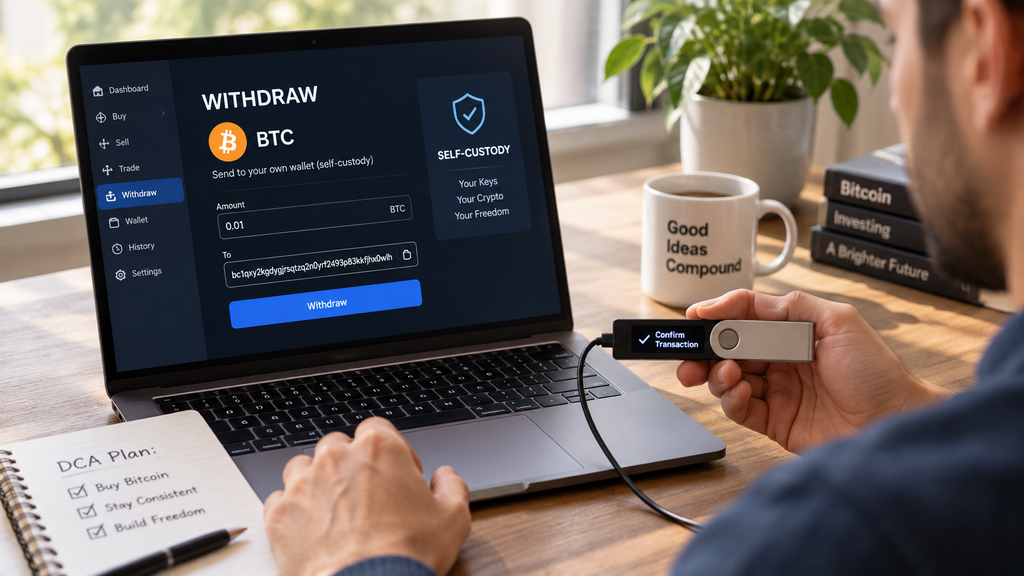
Bitcoin transfer from the exchange to a personal wallet. AI-generated image.
How to Build Your Own DCA Plan
A good DCA plan answers three questions:
- How much? Only money you won’t need for at least one full market cycle (historically about four years). Never invest your emergency fund.
- How often? Weekly and biweekly schedules smooth prices best; monthly is fine if that matches your income.
- Where? Use a reputable exchange with recurring-buy features, and consider withdrawing to self-custody once your position grows.
Write the plan down and automate it. The entire point is to remove emotion and decision fatigue from the equation.

Person putting a small coin into a piggy bank; regular contributions. AI-generated image.
DCA and the Market Cycle
DCA pairs beautifully with the cycle concepts we covered in previous articles. During the accumulation and contraction phases, your fixed contributions buy disproportionately more coins. During expansion, your earlier purchases appreciate. Some investors add a twist — DCA out (selling fixed amounts) near cycle peaks — but the core strategy requires no timing at all.
If you remember the Market Clock: DCA keeps you buying through the trough, holds through expansion, and lets the cycle do the heavy lifting.

Market cycle chart with accumulation and distribution phases. AI-generated image.
Common Mistakes to Avoid
- Stopping during crashes. The red months are when DCA works hardest for you. Pausing there defeats the purpose.
- Overcommitting. A plan you can sustain for years beats an aggressive one you abandon in three months.
- Chasing altcoins with DCA. DCA works best on assets likely to survive multiple cycles. Bitcoin is the classic case; not every altcoin is.
Final Thoughts
Dollar-Cost Averaging won’t make you rich overnight — and that’s exactly why it works. It converts market anxiety into routine, and routine into accumulation. Set the amount, automate the schedule, ignore the noise, and let time in the market do what timing never could.

