Introduction
In October 2026, two assets that both claim to protect you from inflation are telling two completely different stories. Brent crude is trading near $114 a barrel — a five-month high — while Bitcoin sits at $79,769, drifting and worrying its holders. Same war, opposite reactions. Understanding why is one of the most useful lessons a crypto investor can learn.
The Snapshot
Let’s start with the numbers, because they say more than any theory:
- Brent crude: around $113–115 per barrel, the highest since early May, on track for a third consecutive weekly gain of roughly 3.3%.
- WTI: above $100 per barrel.
- Bitcoin: $81,650, down about 1.2% in 24 hours, with a market capitalization near $1.64 trillion.
- S&P 500: 7,663 points, down 1.21% on October 22 — still up roughly 12% year to date.
- Nasdaq Composite: 26,008 points, down 2.6% in a single session.
- Gold: slipped below $4,100.
The war, now in its ninth month, has produced attacks on vessels around the Strait of Hormuz and strikes inside Saudi Arabia, creating a genuine supply shock. Oil responded exactly as textbooks say it should. Bitcoin did not.

Mechanics of a supply shock in the Strait of Hormuz. AI-generated image
Why Oil Spikes in a War
Oil is a physical commodity with a fragile supply chain. Roughly a fifth of the world’s seaborne crude passes through the Strait of Hormuz. When that route is threatened, three things happen at once: tanker insurance and freight rates explode, refiners bid up whatever barrels they can secure, and traders pay a war premium for the risk that supply simply disappears.
This is not speculation — it is arithmetic. You cannot produce a substitute barrel of crude in a week. That inelasticity is why a single attack can move the price 4% in one session.
Why Bitcoin Doesn’t
Bitcoin has no supply chain and no freight cost. Nothing can physically block it. Yet it fell while oil rallied — and this frustrates the “digital gold” narrative every time.
The reason is that markets price Bitcoin as a liquidity asset, not a commodity. Its price depends on how much risk capital is available and how willing investors are to hold volatile assets. When a war threatens inflation, central banks keep rates higher for longer, liquidity tightens, and the first thing institutional portfolios cut is their highest-beta exposure. That is Bitcoin.
Notice the detail that settles the argument: gold also fell below $4,100 in the same period. If the move were purely about inflation fear, gold would have ripped higher. Instead, both gold and Bitcoin weakened while oil surged — a classic liquidity squeeze, not a hedge working.
The Correlation That Actually Matters
Bitcoin’s real relationship is with technology equities, not with commodities. Bloomberg reported in March 2026 that the 30-day correlation between Bitcoin and the S&P 500 surged as volatility returned to markets.
That has a direct consequence: on any given day, Bitcoin is more likely to follow the Nasdaq than to follow gold or oil. When AI-spending worries hit tech stocks — as they did on October 22, dragging the Nasdaq down 2.6% — Bitcoin feels the same chill.
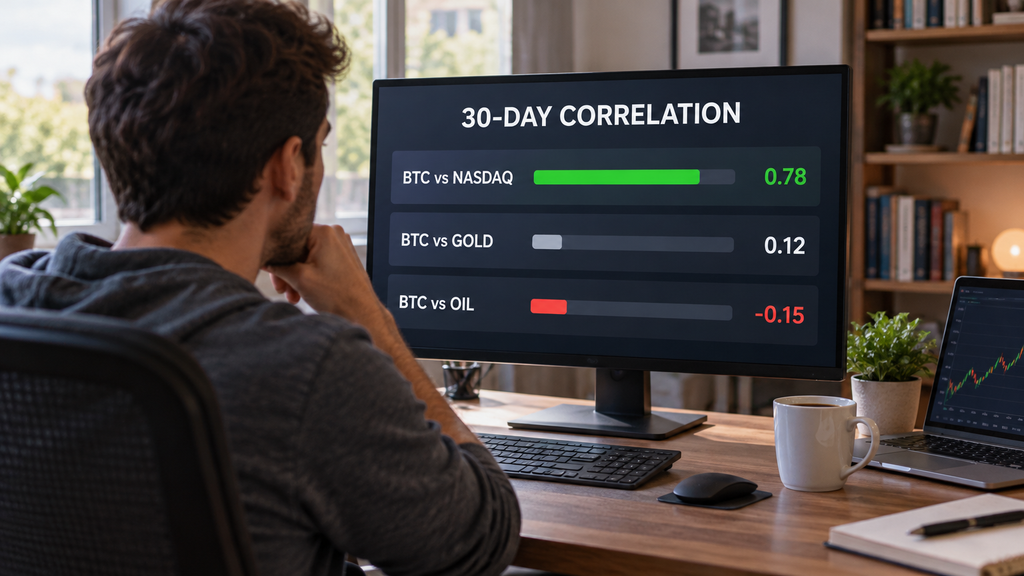
BTC vs. Nasdaq correlation, in contrast to BTC vs. gold and BTC vs. oil. AI-generated image.
Supply Shock vs Liquidity Asset
Here is the mental model that makes everything simple:
- Oil is a supply-shock asset. Its price is set by physical scarcity. Geopolitical damage to supply pushes it up, often violently.
- Bitcoin is a liquidity asset. Its price is set by the availability of risk capital. Anything that drains liquidity pushes it down, even when the cause is inflationary.
These two forces can run in opposite directions at the same time. That is exactly what October 2026 is showing.
What This Means for a Portfolio
Three practical conclusions:
- Stop calling Bitcoin an inflation hedge. It may become one over long horizons, but in a live geopolitical shock it behaves like a high-beta tech asset. Treat it as growth exposure with a risk profile, not as insurance.
- If you want war insurance, look at energy. Oil, energy equities and commodities are the instruments that respond to supply shocks. Bitcoin does not perform that function.
- Watch liquidity, not headlines. The variable that actually moves Bitcoin is the direction of global liquidity and rate expectations. Oil spikes raise inflation expectations; inflation expectations delay rate cuts; delayed cuts pressure Bitcoin. Learn to read that chain and the “surprising” moves stop being surprising.

Chain of effects: oil → inflation → interest rates → liquidity → Bitcoin. Image generated by AI.
How to Position Around It
For traders, the takeaway is about sequencing rather than prediction. In an energy shock, the first move is in oil and energy stocks. The second is in rate expectations. The third is in high-beta risk assets — meaning crypto often lags the macro reaction by days or weeks.
That lag is an opportunity for the patient and a trap for the impatient. Buying Bitcoin the moment a headline breaks about a strike usually means buying before the liquidity effect has fully played out.

Practical panel featuring a “shock sequence” and risk management. AI-generated image.
Final Thoughts
The Iran conflict has handed crypto investors a free lesson: assets are not defined by their marketing, but by the mechanism that prices them. Oil rose because supply was threatened. Bitcoin fell because liquidity tightened. Both reactions were rational.
If you hold Bitcoin, hold it for what it actually is — a scarce, high-beta, liquidity-driven asset. And the next time a war headline hits, watch the ten-year yield before you watch the chart.

